-
Home
- Introduction
-
Tyneside Bridges
-
Wylam to Hexham
-
South Tyne - Hexham to Haltwhistle
-
Warden Railway Bridge
-
Warden Bridge
-
Haydon Bridge Old A69
-
Old Haydon Bridge
-
Haydon Bridge-South Tyne Viaduct
-
Lipwood Railway Bridge
-
Ridley Bridge
-
Ridley Hall Railway Bridge
-
Bardon Mill Footbridge
-
Haltwhistle A69 Bridge (east)
-
Haltwhistle Railway Viaduct
-
Haltwhistle Tyne Bridge
-
Haltwhistle Bellister Bridge
-
Haltwhistle A69 Bridge (west)
-
-
South Tyne - Haltwhistle to Alston
-
South Tyne - Alston to Tyne Source
- North Tyne - Hexham to Kielder
- North Tyne - Kielder to Tyne Source
- Former Bridges
- Proposed Bridges and Tunnels
- Ferries and Tunnels
- Fords
- Reference
- Links
- Bridges on the Derwent
- Bridges on the Tees
- Bridges on the Coquet
- Bridges on the Wansbeck
- Bridges on the Blyth
- Bridges on the Aln
- Bridges on the Wear
- Bridges on the Tweed

SWING BRIDGE
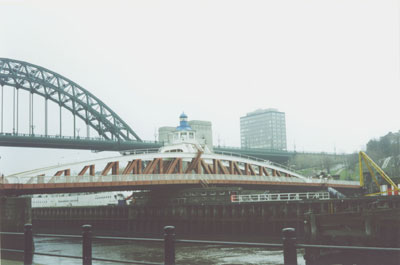
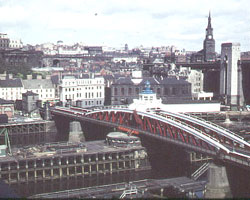
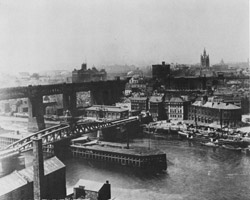
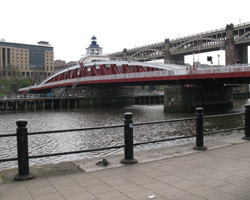
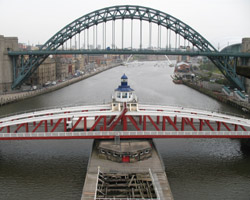
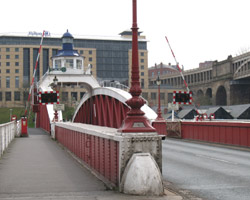
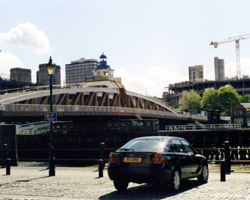
The Swing Bridge has always been one of the most interesting bridges on the Tyne, as until the Gateshead Millennium Bridge came along, it was the only one that moved. Opened in 1876, it was necessary to replace the old Georgian Bridge in almost the same location which was low level and prevented larger vessels from moving up river or above bridge as it was called. This meant that keels were needed to transport coal from the riverbank staiths at Dunston, Derwenthaugh and beyond to the ships further down river, an inefficient and time-consuming process. Armstrong's factories at Elswick were held back due to the impossibility of ships reaching there.
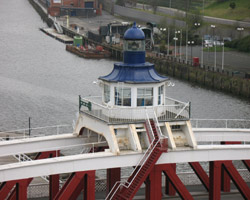
The Tyne Improvement Commission (TIC) was created in 1850 to initiate beneficial changes, regulate and control the Tyne within its tidal limit, allowing towns other than Newcastle to share in the prosperity brought by the river and its increasing industrialisation. In 1861 the TIC were given the go-ahead to build an opening bridge which would replace the existing bridge. Concern was expressed about the delays to traffic with each passage of a ship. After much discussion, obstruction and consideration during which alternatives to the TIC proposal were advocated, the Commission's bridge proposal was adopted as the best and a temporary bridge was erected in 1865/66 to allow the dismantling of the old stone bridge while the new one was built. The temporary bridge opened in 1866. Dredging was done to deepen the river at either side of the bridge and also further up river. Work started on the new bridge in 1868 with W G Armstrong and Co. of Elswick supplying and installing the ironwork and machinery. Three masonry piers were built, the moving part of the bridge revolving through ninety degrees on the centre pier to allow ships to pass on either side. The controls were mounted in the cupola over the roadway and the machinery on the central pier. Power is from two hydraulic engines driven by electric pumps (originally steam-driven) The bridge opened on 15 June 1876, but only to road traffic. The first swing was made for shipping on 17 July 1876 when an Italian navy vessel, the Europa, passed through on its way to Elswick works.
Trade was greatly stimulated after the Swing Bridge opened. Armstrong's Elswick shipyard commenced in 1884 and various other works benefited and coal shipments from northwest Durham became much easier and facilitated the opening of new staiths at Dunston in 1893 and 1903. With the closure of the staiths first at West Dunston in 1934 and then Derwenthaugh in 1960, the number of openings was considerably reduced and finally when Dunston staiths closed in 1980 openings became infrequent although swings have increased a little in recent years as pleasure boats pass through. In 1972 the bridge was operated using a three shift system by a team of 15 men under the control of the Master of the Bridge. It could swing 12 times in one day at that time, each swing taking 6 minutes. In 2002 there were 89 swings up to 14 September. This compares to 6000 in the peak year of 1924, 3000 in 1959 and 900 annually in the 1970s. The ships Bessie Surtees and Hexhamshire Lass which carried fly ash from the Stella power stations for dumping at sea being regular travellers past the bridge, were built low enough to pass under the bridge without the need for its opening. A heatwave could close the bridge when the metal expanded and 'welded' it to its mountings. Then the fire brigade would be called to douse it with water. The solution from the 1960s on was to paint it using a light paint which reflected the heat. The bridge still provides a vital road crossing and is permanently manned.
- Constructed - 1868-76
- Type - swinging, electric/hydraulic operation.
- Position: between Tyne and High Level bridges.
- Grid Ref: NZ 253 637